AO-73 : Funcube-1

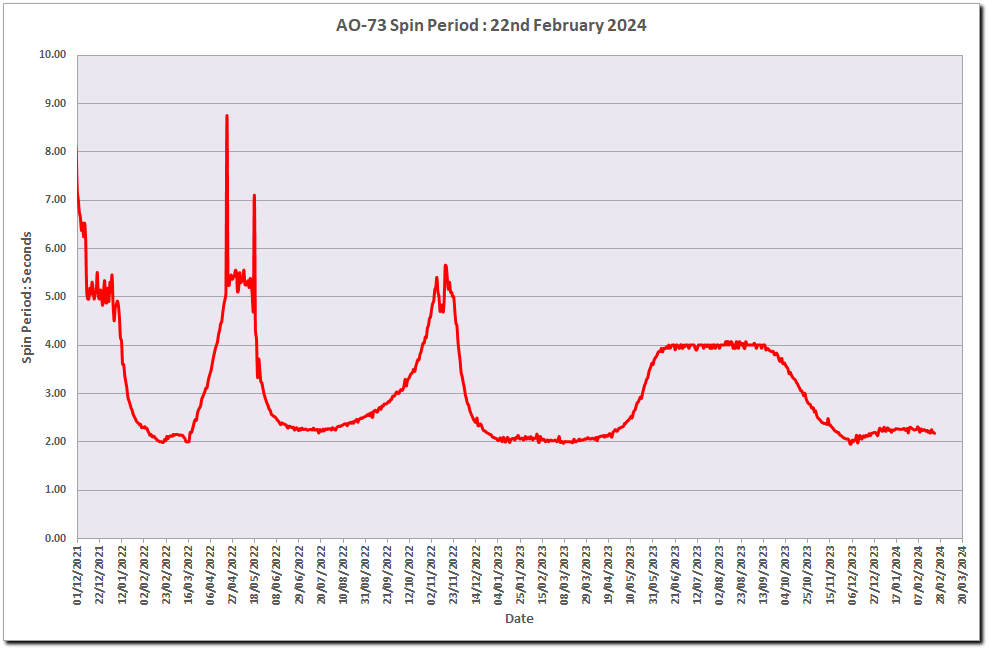
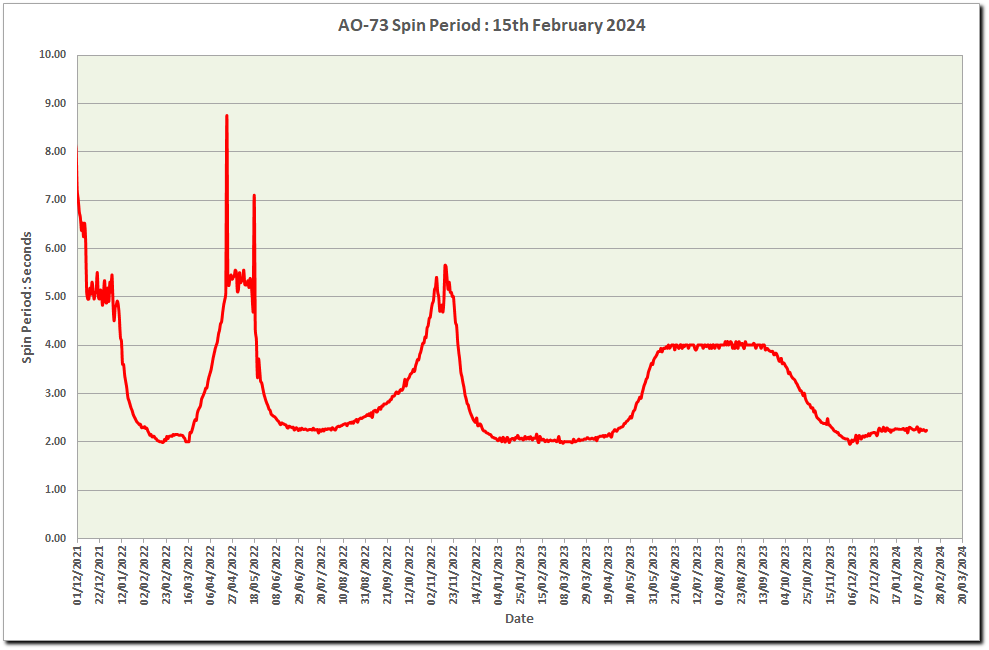
Rotation Period

04 Jul 2025 = 3.86 seconds (from the Sun Sensor Data)
05 Jul 2025 = 3.50 seconds (from the Sun Sensor Data)
06 Jul 2025 = 3.83 seconds (from the Sun Sensor Data)
07 Jul 2025 = 3.86 seconds (from the Sun Sensor Data)
08 Jul 2025 = 3.86 seconds (from the Sun Sensor Data)
09 Jul 2025 = 3.86 seconds (from the Sun Sensor Data)
10 Jul 2025 = 3.86 seconds (from the Sun Sensor Data)
11 Jul 2025 = 3.80 seconds (from the Sun Sensor Data)
12 Jul 2025 =
13 Jul 2025 =
14 Jul 2025 = 3.87 seconds (from the Sun Sensor Data)
15 Jul 2025 = 3.86 seconds (from the Sun Sensor Data)
16 Jul 2025 = 3.90 seconds (from the Sun Sensor Data)
17 Jul 2025 =

Latest WOD downloaded and extracted from the real-time telemetry.

73 de Colin VK5HI.

ISS SSTV event series 28


The images of the SSTV series 28 refer to two important events.

This year marks the 50th anniversary of the Soyuz-Apollo space mission, also known as the ASTP (Apollo-Soyuz Test Project), which was a joint space project of the USSR (Russia) and the United States. Its purpose was to dock the Soyuz and Apollo spacecraft in orbit. This mission, carried out in July 1975, was the beginning of cooperation between the two countries in space exploration.

On July 15, 1975, the Saturn IB rocket with the Apollo command module and docking module launched from Cape Canaveral. On the same day, a Soyuz rocket took off from the Baikonur Cosmodrome, carrying the Soyuz 19 spacecraft. The docking of the Apollo and Soyuz spacecraft took place on July 17, 1975. The crews spent several days in orbit together.


40 years ago, Tony England W0ORE during the Challenger shuttle mission STS 51-F in 1985, he achieved the first ever two-way Slow Scan TV (SSTV) space contact.

Tony was running a Motorola model MX-340 handheld 2-meter transceiver and a Robot Research model 1200C slow-scan television scan converter with an antenna fitted on the inside of one of Challengers windows.

STS-51-F (also known as Spacelab 2) was the nineteenth flight of NASA’s Space Shuttle program, and the eighth flight of Space Shuttle Challenger. It launched from Kennedy Space Center, Florida, on 29 July 1985, and landed at Edwards Air Force Base, California, just under eight days later on 6 August 1985, at 12:45:26 pm PDT.


The diploma shows the Apollo and Soyuz spacecraft approaching each other in orbit, as well as a photograph of Tony England.


Amateur Radio on the International Space Station (ARISS) is a cooperative venture of international amateur radio societies and the space agencies that support the International Space Station (ISS). The primary goal of ARISS is to promote exploration of science, technology, engineering, the arts, and mathematics topics. ARISS does this by organizing scheduled contacts via amateur radio between crew members aboard the ISS and students. Before and during these radio contacts, students, educators, parents, and communities take part in hands-on learning activities tied to space, space technologies, and amateur radio.


AO-73 : Funcube-1

Rotation Period

20 Jun 2025 = 3.70 seconds (from the Sun Sensor Data)
21 Jun 2025 = 4.01 seconds (from the Sun Sensor Data)
22 Jun 2025 = 3.80 seconds (from the Sun Sensor Data)
23 Jun 2025 = 3.80 seconds (from the Sun Sensor Data)
24 Jun 2025 = 3.80 seconds (from the Sun Sensor Data)
25 Jun 2025 =
26 Jun 2025 = 3.80 seconds (from the Sun Sensor Data)
27 Jun 2025 = 3.88 seconds (from the Sun Sensor Data)
28 Jun 2025 = 3.61 seconds (from the Sun Sensor Data)
29 Jun 2025 = 3.86 seconds (from the Sun Sensor Data)
30 Jun 2025 = 3.76 seconds (from the Sun Sensor Data)
01 Jul 2025 = 3.79 seconds (from the Sun Sensor Data)
02 Jul 2025 = 3.86 seconds (from the Sun Sensor Data)
03 Jul 2025 = 3.86 seconds (from the Sun Sensor Data)

73 de Colin VK5HI.

new SSTV activity from ISS

From Monday, 14 July 2025, at approximately 0945 UTC until Sunday, 20 July 2025, at approximately 1800 UTC, the ISS is scheduled to broadcast SSTV again. This is the 28th series of image transmissions, this time focusing on the 50th anniversary of the Apollo-Soyuz Test Project (ASTP) and the 40th anniversary of the STS-51-F mission (Space Transportation System), which launched as the 19th space shuttle mission with Challenger on 29 July 1985.
This mission was already the second SAREX flight (Shuttle Amateur Radio Experiment), but the first in which an SSTV transmission was made in manned spaceflight.

The Challenger is still a sad memory for many of us since it exploded 73 seconds after launch on 28 January 1986 during the STS-51-L mission. The entire crew was killed.

The twelve images are transmitted in PD120 mode on the frequency 145.800 MHz.

Anyone who uploads a received and decoded image to http://ariss-usa.org/ARISS_SSTV will receive a corresponding certificate by email.

AO-73 : Funcube-1

Rotation Period
23 May 2025 = 2.82 seconds (from the Sun Sensor Data)
24 May 2025 = 2.82 seconds (from the Sun Sensor Data)
25 May 2025 = 2.88 seconds (from the Sun Sensor Data)
26 May 2025 = 2.92 seconds (from the Sun Sensor Data)
27 May 2025 = 3.00 seconds (from the Sun Sensor Data)
28 May 2025 = 3.03 seconds (from the Sun Sensor Data)
29 May 2025 = 3.16 seconds (from the Sun Sensor Data)
30 May 2025 = 3.17 seconds (from the Sun Sensor Data)
31 May 2025 = 3.26 seconds (from the Sun Sensor Data)
01 Jun 2025 = 3.27 seconds (from the Sun Sensor Data)
02 Jun 2025 = 3.23 seconds (from the Sun Sensor Data)
03 Jun 2025 = 3.32 seconds (from the Sun Sensor Data)
04 Jun 2025 = 3.36 seconds (from the Sun Sensor Data)
05 Jun 2025 = 3.41 seconds (from the Sun Sensor Data)
06 Jun 2025 = 3.47 seconds (from the Sun Sensor Data)
07 Jun 2025 = 3.50 seconds (from the Sun Sensor Data)
08 Jun 2025 =
09 Jun 2025 = 3.56 seconds (from the Sun Sensor Data)
10 Jun 2025 = 3.53 seconds (from the Sun Sensor Data)
11 Jun 2025 = 3.62 seconds (from the Sun Sensor Data)
12 Jun 2025 = 3.65 seconds (from the Sun Sensor Data)
13 Jun 2025 = 3.67 seconds (from the Sun Sensor Data)
14 Jun 2025 = 3.67 seconds (from the Sun Sensor Data)
15 Jun 2025 = 3.70 seconds (from the Sun Sensor Data)
16 Jun 2025 = 3.65 seconds (from the Sun Sensor Data)
17 Jun 2025 = 3.69 seconds (from the Sun Sensor Data)
18 Jun 2025 = 3.73 seconds (from the Sun Sensor Data)
19 Jun 2025 = 3.77 seconds (from the Sun Sensor Data)

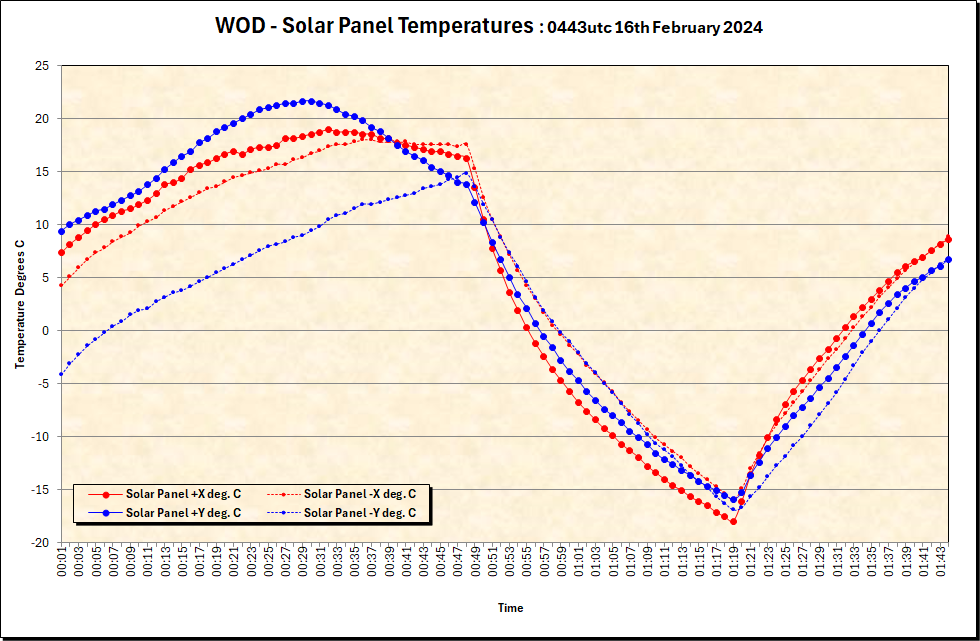
Latest WOD downloaded and extracted from the real-time telemetry
73 de Colin VK5HI.